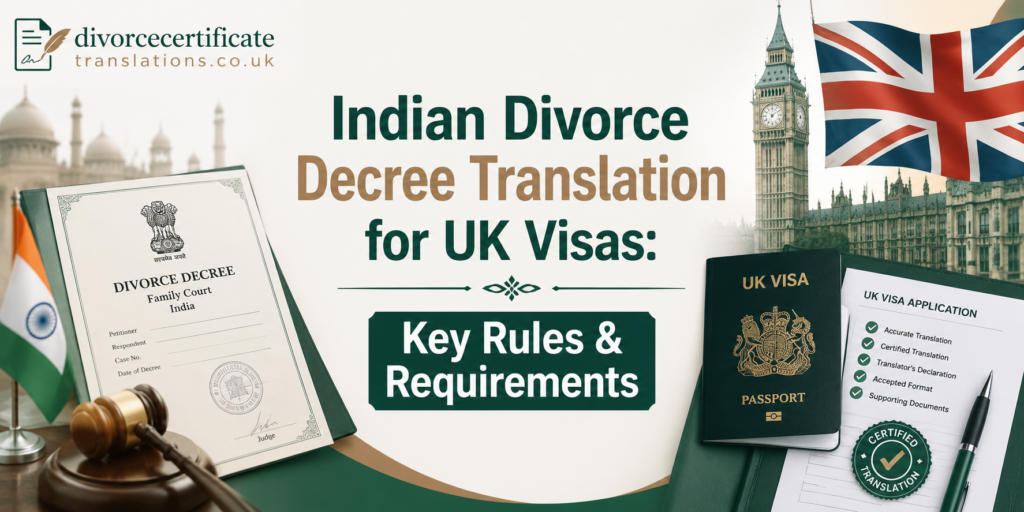
UKVI requires a full certified English translation of every element on your Indian divorce decree — including court seals, the certified true copy endorsement, filing stamps and handwritten annotations, even when the main judgment is already written in English. The most common Indian divorce decree translation requirements for UK visa applications are missed for exactly this reason: applicants translate nothing because the paragraphs look English, while the Devanagari or regional-script markings around them go unrendered.
At Divorce Certificate Translations, our team fields the same message almost daily from applicants across Delhi NCR, Mumbai, Punjab and Kerala: “my decree is already in English, do I really need this?” In our experience, that assumption causes more spouse visa problems than any language barrier ever does. Over the years we have reviewed thousands of Indian family court decrees and found untranslated content on the vast majority of them. That is why our first step is always to look at your actual page before we quote you anything.
Does Ukvi Accept An Indian Divorce Decree?
Yes — Indian decrees are accepted, provided the full document is supplied in English with a compliant certification statement. The decree itself is rarely the problem; how it is presented is.
For a spouse or partner visa under Appendix FM, a caseworker must be satisfied that any previous marriage was legally dissolved before the current relationship can qualify. Your Indian Decree of Divorce is exactly the right evidence for that.
Where applications come unstuck is the standard applied. A caseworker cross-references the translation against the original, line by line and mark by mark. Anything visible on the original that is absent from the English version is treated as unverified — and unverified evidence carries no weight in a decision.
“My Decree Is Already In English” — Why That Is The Riskiest Assumption
Most Indian family court decrees have an English judgment body but non-English official markings. Those markings are precisely what proves the document is authentic.
Look at your own decree again and check for these five things. In our experience at least three appear on nearly every Indian decree we handle:
- The court seal — almost always in Devanagari or the state’s regional script, circling the court name and district
- The certified true copy endorsement — applied by the court’s copying agency, frequently part-printed and part-handwritten in Hindi, Marathi, Gujarati, Tamil or Malayalam
- Filing and issue stamps — date of application, date of delivery, fee stamps, copying-agency reference numbers
- The signature block — the judge’s or reader’s designation, often abbreviated in script
- Margin annotations — handwritten corrections, page references, or notes on when the decree became final
Each of these is content. A caseworker cannot tell what a seal says if nobody has told them. What we do instead is render every one of them in position, describing where each appears on the page, so the English version is a genuine mirror of the original rather than a tidy summary of its readable parts.
This is also why a bilingual friend or a relative in India cannot safely do this for you. Reading the seal is one skill. Certifying it in the format UKVI expects is another.
Which Indian Divorce Document Do You Actually Have?
Indian divorces are granted under different personal laws, and the document you hold depends on which one applied to your marriage. UKVI does not require a specific format, but it does require the document to prove dissolution clearly.
| Your document | Issued under | What it looks like | Usual UK visa position |
|---|---|---|---|
| Decree of Divorce (mutual consent) | Section 13B, Hindu Marriage Act 1955 | Family court judgment, English body, vernacular seals | Primary evidence — most common |
| Decree of Divorce (contested) | Section 13, Hindu Marriage Act 1955 | Longer judgment, findings included | Primary evidence |
| Decree of Divorce | Special Marriage Act 1954 | District court decree, civil marriages | Primary evidence |
| Divorce Deed / Talaqnama | Muslim personal law | Notarised deed, often Urdu or Hindi throughout | Accepted, but usually needs supporting registration |
| Decree of Dissolution | Indian Divorce Act 1869 (Christian) | District court decree, sometimes church record attached | Primary evidence |
| Decree of Divorce | Parsi Marriage & Divorce Act 1936 | Parsi Chief Matrimonial Court | Primary evidence |
Two clarifications our specialists give constantly. First, India has no “decree absolute” — that is an England and Wales term. An Indian decree becomes final once the appeal period passes; there is no second certificate to chase, so do not delay your application looking for one. Second, most Indian states issue no separate divorce certificate at all. The court decree is the certificate.
Which Copy Should You Submit — And Which Gets Rejected
UKVI expects the court-issued certified true copy, not your lawyer’s photocopy or a scanned duplicate. This is one of the most frequent avoidable errors we see.
In India, you obtain a certified copy by applying to the court’s copying agency, which issues a stamped and endorsed copy carrying the court seal. That endorsement is the document’s proof of origin. A plain photocopy of that copy loses the raised seal, dulls the stamps and often crops the margins — and once the markings are unreadable, they cannot be translated, which puts you back at square one.
Before you send anything to us, check that your copy shows the complete seal, that the endorsement text is legible, and that nothing has been trimmed at the edges. If parts are faint, tell us — our editors mark genuinely illegible content with a translator’s note rather than guessing, which is far safer than a confident wrong reading.
We prepare these translations for applicants applying from India and for clients already settled in London, Birmingham, Manchester, Leeds, Glasgow and Liverpool. If you are mid-application, our UKVI translation page explains how we format for each route.
Do You Need An Apostille As Well?
For a UK visa application, an MEA apostille is usually not required — UKVI generally asks for the document and a certified translation. Apostilles matter more when Indian documents are used by other authorities or abroad.
India joined the Hague Apostille Convention, so the Ministry of External Affairs can apostille a decree after state-level authentication. Some applicants are told by agents in India that this is mandatory for every UK purpose. It is not, and paying for it unnecessarily adds weeks.
That said, requirements vary by route, by authority and occasionally by caseworker request. Our advice would be simple: check your specific application guidance or confirm with your immigration adviser first, and if an apostille is needed, tell us — we translate the apostille certificate too, because it is part of the document once attached.
Names, Spellings And The Detail That Triggers Questions
Indian decrees frequently spell names differently from passports, and caseworkers notice. Transliteration from regional scripts has no single standard.
Sunita on the decree and Suneeta on the passport. A surname written in full on one document and initialised on the other, which is common with South Indian names where the father’s name forms an initial. A married surname on the decree that no longer appears on current ID.
We translate names exactly as they appear on the original — never corrected to match your passport, because silently “fixing” a name is an alteration, not a translation. Where a genuine discrepancy exists, let us know when you order and our editors add a clear translator’s note explaining the transliteration difference. That one line answers the caseworker’s question before it becomes a query. The same applies afterwards if you are updating UK records through our name change translation service.
Before You Upload Your Documents
- ✔ Court-issued certified true copy in hand, not a plain photocopy
- ✔ Full seal, endorsement and stamps visible and legible on your scan
- ✔ Every page scanned, including reverse sides carrying stamps
- ✔ Translation covers seals, endorsements, signatures and margin notes — not just the judgment
- ✔ Certification statement with the translator’s name and contact details attached
- ✔ Any name or spelling difference flagged to your translator in advance
- ✔ Original and translation submitted together
Frequently Asked Questions
My Indian Divorce Decree Is In English — Do I Still Need A Translation?
Almost certainly yes. Indian decrees carry court seals, certified true copy endorsements, filing stamps and often handwritten notes in Devanagari or a regional script. UKVI expects every element of the document in English, so a partial translation of an otherwise English decree is still an incomplete submission.
Can My Lawyer In India Translate My Divorce Decree?
Not advisably. The translation must come from an independent professional translator with a signed certification statement giving their name and contact details. A lawyer involved in your case has a conflict of interest, and translations lacking UK-standard certification are commonly rejected regardless of accuracy.
Is An Indian Decree Of Divorce The Same As A Decree Absolute?
No. “Decree absolute” is an England and Wales term with no Indian equivalent. An Indian Decree of Divorce becomes final once the appeal period has expired, and no second certificate is issued. Submit the certified true copy of the decree itself as your evidence.
Do I Need An Apostille On My Indian Divorce Decree For A Uk Visa?
Usually not. UKVI generally requires the document plus a certified English translation rather than an MEA apostille. Requirements can vary by route and by case, so confirm against your specific application guidance first — and if an apostille is added, it must be translated too.
How Long Does An Indian Divorce Decree Translation Take?
Standard turnaround is typically a few working days, with express and same-day options when your biometric appointment or submission deadline is close. Multi-page contested judgments take longer than mutual consent decrees, so send us the full document early for an accurate timeline.
Send Us The Page Before You Send It To Ukvi
The costliest mistake in an Indian divorce decree submission is not a mistranslation — it is a translation that was never ordered, because the decree looked English enough to skip. That is why our first step is always to review your actual document, show you exactly which seals, endorsements and stamps are sitting there untranslated, and only then give you a price.
We have guided thousands of applicants and immigration advisers through spouse visa, partner visa and register office submissions with Indian court decrees, so our translators know which markings a caseworker checks and how each one should appear in English. Every translation we deliver carries a signed certification statement, a named accountable translator, and a layout that mirrors your original page for page, with seals rendered in position rather than summarised. Your decree contains sensitive personal information, and it is seen only by the translator assigned to your file. If your biometric appointment is already booked, our express and same-day options exist for exactly that pressure.
Fill in the quote form with a clear photo of your decree and let us handle it — we will tell you what is missing, what it costs, and when it lands, before you commit to anything.