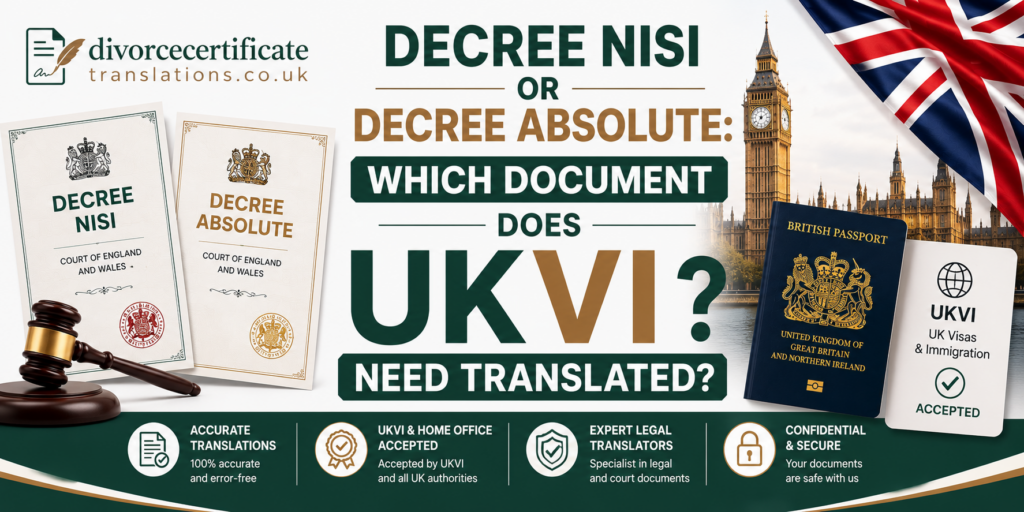
In most UKVI applications, you’ll usually need to translate the document that proves your divorce is legally final. For divorces granted in England and Wales before 6 April 2022, this is normally the Decree Absolute. The Decree Nisi is an earlier court order and doesn’t legally end the marriage. However, every application is different, and some applicants may be asked to provide additional divorce documents depending on their circumstances.
One of the most common questions we hear at Divorce Certificate Translations UK is, “Do I need to translate my Decree Nisi or my Decree Absolute for UKVI?” The confusion is understandable because both documents are issued during the divorce process, and many applicants aren’t sure which one proves their divorce has legally ended.
Choosing the wrong document can lead to unnecessary delays, additional translation costs and requests for further paperwork. In our experience, many people order a certified translation before confirming which divorce document their application actually requires.
This guide explains the difference between Decree Nisi and Decree Absolute, how the divorce process changed in 2022, and which document UKVI usually expects when you need to prove that your marriage has legally ended.
What Is a Decree Nisi?
A Decree Nisi was a court order used in England and Wales before 6 April 2022. It confirmed that the court had accepted there were legal grounds for the divorce to proceed.
However, it’s important to understand that a Decree Nisi did not legally end the marriage. It was an intermediate stage in the divorce process, giving both parties time before the divorce became final.
Think of it as the court saying:
“Your divorce can go ahead, but it isn’t legally complete yet.”
Since 6 April 2022, the Decree Nisi has been replaced by the Conditional Order under the UK’s no-fault divorce system. Although the name has changed, its purpose remains largely the same—it confirms that the divorce can proceed but doesn’t officially end the marriage.
What Is a Decree Absolute?
The Decree Absolute was the final court order that legally ended a marriage in England and Wales before 6 April 2022.
Once the court issued the Decree Absolute:
- The marriage legally ended.
- Both parties became legally divorced.
- Either person could remarry if they wished.
- The document became the official proof that the divorce had been completed.
For many official purposes, including immigration and legal applications, this is the document that demonstrates the marriage has legally ended.
Since 6 April 2022, the Decree Absolute has been replaced by the Final Order, which now serves the same legal purpose under the current divorce process.
Decree Nisi vs. Decree Absolute
Although both documents were part of the same divorce process, they served very different legal purposes.
| Feature | Decree Nisi | Decree Absolute |
|---|---|---|
| Purpose | Confirms the divorce can proceed | Legally ends the marriage |
| Marriage Status | Still legally married | Legally divorced |
| Divorce Stage | Intermediate court order | Final court order |
| Current Name (after April 2022) | Conditional Order | Final Order |
| Usually Used as Proof of Divorce | No | Yes |
| Translation for UKVI | Depends on the application | Usually the relevant document where proof of final divorce is required |
The key difference is simple:
A Decree Nisi starts the final stage of the divorce process, while a Decree Absolute completes it.
Which Document Does UKVI Usually Need?
This is where many applicants become confused.
In most cases, UKVI isn’t interested in whether the divorce process started—it usually needs evidence that the divorce was legally completed. That’s why the Decree Absolute (or Final Order for divorces granted after April 2022) is typically the more relevant document when proof of divorce is required.
We’ve seen applicants mistakenly translate a Decree Nisi because they assumed it was the final divorce document. Unfortunately, this often leads to extra work when they later discover that the document proving the divorce was legally final is the one needed for their application.
That said, every UKVI application is different. Depending on your immigration route, personal circumstances or supporting evidence, you may be asked to provide additional documents alongside your final divorce order. For that reason, it’s always worth checking the document requirements for your specific application before arranging a certified translation.
When Might You Need to Translate Both Documents?
Although the Decree Absolute is usually the document that proves a divorce has legally ended, there are situations where translating both documents may be helpful or necessary.
For example, you may be asked to provide additional divorce paperwork if:
- A UK authority requests further evidence about the divorce process.
- Your divorce documents don’t clearly explain the legal outcome.
- You’re submitting documents issued outside the UK alongside English divorce records.
- A solicitor, court or another organisation requests the complete divorce history.
In our experience, these situations are less common, but they do happen. If you’re unsure which document should be translated, confirming the requirements before ordering a certified translation can help you avoid unnecessary costs and delays.
What If Your Divorce Was Outside the UK?
Not every divorce document issued outside the UK uses terms like Decree Nisi or Decree Absolute. Different countries follow different legal systems, so the document proving that your divorce is legally final may have a completely different name.
For example, your divorce documents may be called:
- Divorce Decree
- Final Divorce Judgment
- Divorce Certificate
- Judgment of Dissolution
- Court Divorce Order
Although the names vary, the key question remains the same:
Does the document legally confirm that your marriage has ended?
We regularly translate foreign divorce documents from different legal systems. One of the first things we check is whether the document represents the final divorce order or simply records an earlier stage of the divorce process. Identifying the correct document before translation helps applicants avoid unnecessary costs and delays.
How the Divorce Process Changed in 2022
The divorce process in England and Wales changed on 6 April 2022 when the no-fault divorce law came into effect.
Although the legal process became simpler, many people are still confused because older divorce documents use different terminology.
| Before 6 April 2022 | From 6 April 2022 |
|---|---|
| Decree Nisi | Conditional Order |
| Decree Absolute | Final Order |
The names changed, but the purpose of each document remained largely the same.
- Conditional Order confirms that the divorce can proceed.
- Final Order legally ends the marriage.
If your divorce was granted before April 2022, your documents will normally refer to Decree Nisi and Decree Absolute. If it was granted after that date, you’ll usually receive a Conditional Order and Final Order instead.
When arranging a certified translation, it’s important to identify which version of the divorce documents you have before submitting them with your UKVI application.
Common Mistakes We See When Translating Divorce Documents
We’ve found that most translation problems don’t happen because the translation itself is difficult. They happen because applicants submit the wrong document or overlook important details before the translation even begins.
Here are some of the most common mistakes we see:
Translating the Wrong Divorce Document
Many applicants request a translation of the Decree Nisi without realising that the Decree Absolute is usually the document proving the divorce is legally final.
Sending Incomplete Documents
Sometimes only the first page of a divorce order is uploaded, while pages containing court stamps, signatures or final court decisions are missing. Every page forms part of the official legal record and should normally be included for translation.
Assuming Every Country Uses UK Terminology
Foreign divorce documents rarely follow the same format as documents issued in England and Wales. The title of the document may be different even though it serves the same legal purpose. Identifying the correct document before translation is often more important than simply translating the first document available.
Ordering a Translation Too Early
Some applicants arrange a certified translation before confirming exactly which documents their application requires. Checking the document requirements first can often save both time and money.
Frequently Asked Questions
Do I need to translate both the Decree Nisi and the Decree Absolute?
Not usually. In most situations where proof of divorce is required, the document confirming that the marriage has legally ended is the most relevant. However, some applications or authorities may request additional supporting divorce documents depending on the circumstances.
What replaced the Decree Nisi?
Since 6 April 2022, the Conditional Order has replaced the Decree Nisi in England and Wales. It performs a similar role by confirming that the divorce can proceed but doesn’t legally end the marriage.
What replaced the Decree Absolute?
The Final Order replaced the Decree Absolute on 6 April 2022. It is the document that legally ends the marriage under the current no-fault divorce system.
Will UKVI accept a Final Order instead of a Decree Absolute?
Yes. If your divorce was completed after the legal changes introduced in April 2022, your final divorce document will normally be called a Final Order rather than a Decree Absolute.
Can I translate my Decree Absolute myself?
If your application requires a certified translation, translating the document yourself is generally not appropriate. A certified translation should be prepared by a professional translation provider and include the certification details commonly requested for official UK applications.
What if my divorce document comes from another country?
Foreign divorce documents often use different legal terminology and formats. A professional translator can identify the document correctly and prepare a certified translation that accurately reflects the original while preserving important legal information.
Conclusion
Understanding the difference between a Decree Nisi and a Decree Absolute can help you avoid one of the most common mistakes applicants make when preparing documents for UKVI. While the Decree Nisi confirmed that a divorce could proceed, the Decree Absolute was the document that legally ended the marriage. Since April 2022, these documents have been replaced by the Conditional Order and Final Order, but the same principle still applies—the final divorce order is usually the document needed when you must prove that your marriage has legally ended.
At Divorce Certificate Translations UK, we specialise in certified translations for divorce documents submitted to UK authorities. Before every translation, we carefully review the document type, legal terminology and supporting pages to help ensure you’re translating the correct document from the outset. This approach helps many applicants avoid unnecessary delays, duplicate translation costs and requests for additional paperwork.
If you’re unsure which divorce document needs translating, contact Divorce Certificate Translations UK today. We’ll review your documents and help you identify the appropriate document before preparing a professionally certified translation for your UK application.