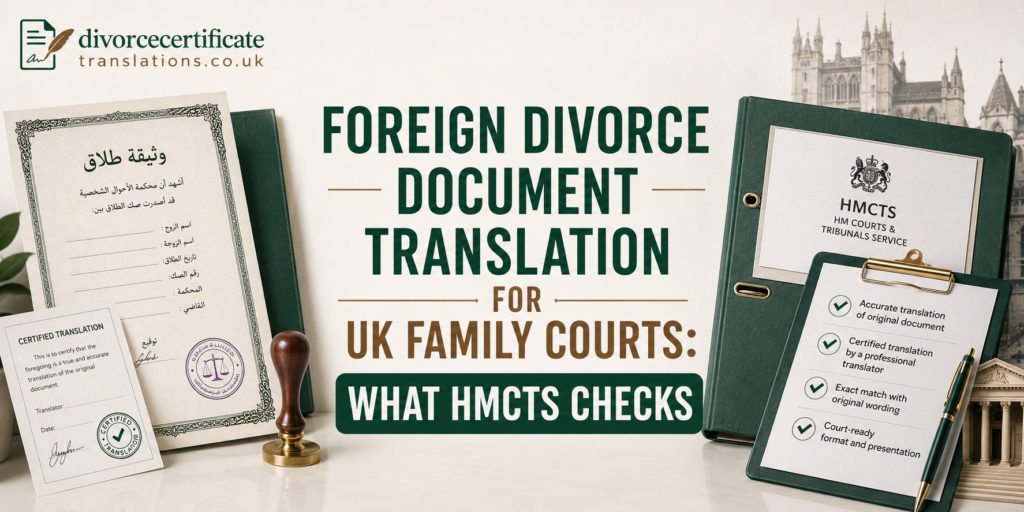
⚡ Quick Answer: HMCTS court staff do not decide whether your overseas divorce is valid — they check whether your filing complies with the Family Procedure Rules. In England and Wales, any foreign divorce document not written in English or Welsh must be filed together with a full English translation, and Practice Direction 22A (paragraph 8.2) requires the translator to sign that translation and certify it as accurate. Rule 6.47 of the Family Procedure Rules sets out that a translation must carry a statement from the translator giving their name, address and qualifications. Whether the divorce is legally recognised in the UK is a separate question, decided by a judge under sections 46 and 55 of the Family Law Act 1986 — not at the court counter.
You’ve got a divorce decree from Lahore, Warsaw, Madrid or Lagos in a folder, a hearing date circled on the calendar, and one question nobody answers straight: will the court accept this?
Most people worry about the wrong thing. They picture a court officer interrogating whether their divorce was “proper”. In practice, the first person handling your foreign divorce documents in a UK family court is a court officer or legal adviser running a procedural check — far narrower than applicants expect. Good news, because your divorce isn’t on trial at the filing stage. Bad news, because filings get sent back for reasons unconnected to your case: a missing page, an untranslated stamp, a certification line that doesn’t say what the rules require. At Divorce Certificate Translations, our certified translators prepare court-bound divorce paperwork every week, and the rejections we fix are almost always procedural.
What The Court Is Actually Looking At When Your Paperwork Lands
Proceedings in England and Wales are conducted in English, and that drives everything else. A document the court cannot read is one it cannot rely on, so the rules put the burden on you — the party relying on the evidence — to file a complete, verified English version.
Staff assess compliance, not truth. Nobody is contacting a foreign registry to confirm your decree exists. They’re confirming something narrower: that the bundle is complete, the English version properly certified, and the document capable of being relied on.
📌 KEY TAKEAWAYS:
- ✔ The court checks procedural compliance, not the validity of your overseas divorce.
- ✔ Your foreign-language original must be filed alongside the English translation — not replaced by it.
- ✔ The translator, not you, certifies the translation’s accuracy and puts their name to it.
- ✔ Recognition of the divorce itself is a separate legal question for a judge.
- ✔ Scotland and Northern Ireland run their own court systems; the rules below apply to England and Wales.
The Four Checks That Decide Whether Your Filing Goes Through
Is Every Page Of The Original Actually There?
The most common failure we see, and the most avoidable. Applicants photograph the page with the seal and stop. But a decree from an Indian family court, a Polish wyrok rozwodowy or a Pakistani Union Council certificate is often a multi-page instrument — order sheet, decree sheet, endorsement page, a registry annotation on the reverse.
A court officer isn’t reading Urdu or Polish, but they can see page numbering that jumps, a reference to an annexe that isn’t in the bundle, or a translation stopping mid-clause. Partial documents get queried, and a query often costs a week.
Is The English Version Certified The Way The Rules Require?
This is where a cheap translation, or one done by a bilingual relative, quietly falls over. The rules don’t ask for a translation — they ask for a verified one. Practice Direction 22A, paragraph 8.2, is explicit that the translator must sign and certify accuracy, and rule 6.47 expects a filed translation to carry a statement naming the translator with their address and qualifications.
What court officials rarely tell you is why that matters: the certification exists so a named, contactable person can be held accountable if the translation is challenged. A translation with no traceable author gives the court nothing to stand on.
Does The Translation Cover The Whole Page — Including The Parts That Aren’T Sentences?
Foreign court documents are dense with non-prose content: round seals, registrar stamps, court emblems, handwritten marginal notes, file and revenue stamps. Applicants assume these don’t need translating. They do — a certified copy of a foreign divorce decree draws much of its authority from exactly those markings, which show it came from a court rather than a printer. Our legal translation experts render every stamp and annotation, describing untranslatable elements in square brackets, so the English version mirrors the original page for page.
Do The Names And Dates Reconcile Across Your Bundle?
A judge reading a financial remedy or child arrangements bundle needs one consistent person running through it. Transliteration makes that harder than it sounds — Mohammed and Muhammad, Yusuf and Yousef, a Cyrillic surname with three defensible spellings, a Hijri date needing conversion to the Gregorian calendar. We frequently see applicants caught out because the translation is correct but doesn’t match their passport. Flag known variations to your translator up front, so a short note settles it before anyone raises it in court.
Document Requirements Matrix: What The Court Expects To See
| What you file | What the court is checking | Common reason it’s queried |
|---|---|---|
| Foreign divorce decree or certificate (original language) | Complete, legible, court-sealed or registry-issued | Only one page supplied; reverse side omitted |
| Full English translation | Every element rendered, layout mirrors original | Stamps, seals and marginal notes left untranslated |
| Translator’s certificate of accuracy | Signed, dated, translator named and contactable | Generic agency slip with no individual signature |
| Translator’s qualifications and contact details | Traceable to a real, accountable professional | Certified by a friend, relative or the applicant |
| Supporting IDs and application forms | Names and dates consistent across the bundle | Passport spelling differs from translated decree |
| Court bundle pagination | Original and translation kept together and indexed | Translation filed loose, separated from its original |
💡 PRO TIP: File the original and its translation as a paired set, indexed together in the bundle. Judges cross-reference the two side by side, and a translation that’s been separated from its source page is markedly harder to rely on.
Recognition Is A Different Question — Don’T Confuse The Two
Here’s the distinction that saves people real money. Getting documents accepted as evidence and getting your divorce recognised in UK law are separate hurdles, decided by different people at different times.
The first is procedural, and it’s what this guide covers. The second is governed by the Family Law Act 1986 — section 46 sets out when an overseas divorce is recognised here, and section 55 lets a court declare marital status where it’s in doubt. That turns on where the divorce took place, the procedure followed, and the parties’ domicile or habitual residence at the time.
A flawless translation cannot make an unrecognised divorce recognised. It puts the evidence before the judge in a form they can properly assess. Where recognition is doubtful — particularly with religious divorces or decrees from jurisdictions without a formal court process — take advice from a family law solicitor alongside the translation.
Before You File: The Errors That Send Bundles Back
- 📌 Submitting a plain photocopy where the court expects a certified true copy issued by the originating court or registry.
- 📌 Filing only the English version and keeping the foreign-language original at home. Both go in.
- 📌 Self-certifying. You cannot verify your own document’s translation; the accountability has to sit with an independent translator.
- 📌 Assuming an apostille replaces a translation. Legalisation and translation answer different questions and neither substitutes for the other.
- 📌 Leaving it to the week of the hearing. Court-ready work needs checking time, and adjournments are expensive.
Frequently Asked Questions
Does A Translation For A Uk Family Court Need To Be Notarised?
Not usually. For most family filings a certified translation carrying the translator’s signed statement of accuracy is what the rules call for. Notarisation is an additional layer some authorities or overseas bodies specifically request — check whether your court or solicitor has actually asked for it before paying for it.
Do Uk Courts Accept Foreign Divorce Certificates?
Courts accept them as evidence when they’re properly filed — complete, with a certified English translation attached to the original. Acceptance as evidence is not the same as the divorce being recognised in UK law, which is decided separately under the Family Law Act 1986.
My Decree Is In A Regional Language, Not The National One. Does That Matter?
Only in that your translator must genuinely work in that language and dialect. A Gujarati decree translated by a Hindi speaker, or a Maghrebi document handled by someone trained on Gulf Arabic, is exactly where errors creep in.
How Long Does A Certified Translation For Court Usually Take?
Standard turnaround runs a few working days, with express and same-day dispatch available for hearing deadlines. Build in a day for you to check names and dates before it goes anywhere near the bundle.
Does This Apply In Scotland And Northern Ireland?
No. HMCTS administers courts in England and Wales. Scotland and Northern Ireland have separate court systems and their own procedural rules, so confirm requirements locally if your case sits there.
📌 Protect Your Family Court Filing With Court-Ready Certified Translations
Court deadlines don’t move because a document came back over a formatting point. Our in-house specialists prepare divorce decrees, court orders and settlement papers for UK family proceedings every week, in the certification format the Family Procedure Rules call for — a named translator, a signed statement of accuracy, wet-ink or digital signature as your filing requires, and every stamp and seal accounted for. If a court officer raises a genuine error with our certification, our certified translators correct it at no additional charge, and your documents stay strictly confidential throughout.
Send a clear scan or photo before you commit to anything. Our legal translation experts will confirm which document you’re holding, what needs translating on it, and how fast it can be ready for your hearing date. No obligation, no pressure — just get your court translation reviewed and quoted free and walk into your filing knowing the paperwork won’t be what holds you up.