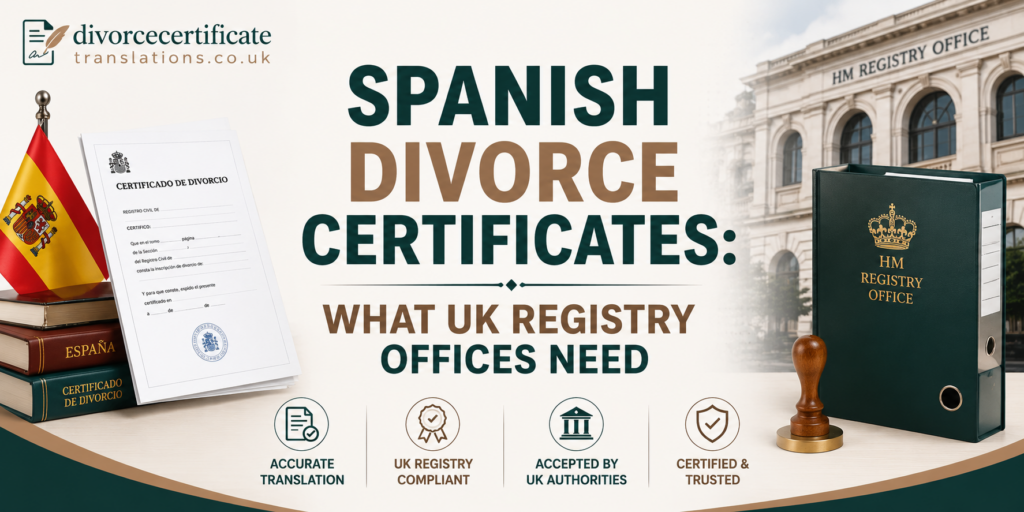
Spain issues no standalone divorce certificate. What proves a Spanish divorce is the certificado literal de matrimonio — the full marriage certificate carrying a nota marginal de divorcio (a marginal annotation recording the dissolution). For a Spanish divorce certificate translation for UK register office use, you need that literal version, translated in full into English with a signed certificate of accuracy.
At Divorce Certificate Translations UK, our team sees the same conversation every week: someone sends a Spanish document, asks for a quick translation, and within seconds we can tell the page will never satisfy a superintendent registrar — not because of the language, but because of the version. Over the years we have watched wedding dates slip for exactly this reason, and it is almost always avoidable. That is why we check what you are holding before you pay us anything.
Does Spain Issue a Divorce Certificate?
No — Spain records divorce onto the marriage entry that already exists. The Registro Civil never opens a new file for a dissolution.
When a Spanish court issues a sentencia de divorcio (divorce judgment), or a notary executes an escritura notarial de divorcio (available in uncontested cases without minor children), the court or notary notifies the civil registry holding the marriage record. The registry then adds a nota marginal — a note in the margin stating the marriage was dissolved, on what date, and by which procedure.
So the paper proving you were married is the same paper proving you no longer are. Only that annotation separates the two. Searching for a “certificado de divorcio” leads nowhere because it was never created.
Which Version of the Certificate Do You Actually Need?
Only the certificado literal de matrimonio reproduces marginal notes. Request any other format and the divorce simply will not appear on the page.
| Document | What it shows | Proves the divorce? |
| Certificado literal de matrimonio (with nota marginal) | Complete registry entry, all marginal annotations included | Yes — request this one |
| Certificado en extracto | Short summary of the marriage only | No — marginal notes omitted |
| Certificado plurilingüe | Multilingual summary for EU use | No — also an extract |
| Sentencia de divorcio | The court’s judgment | Supporting evidence, rarely accepted alone |
| Escritura notarial de divorcio | Notarial divorce deed | Supporting evidence, rarely accepted alone |
| Acta de divorcio (Latin America) | A genuine standalone divorce record | Yes, where issued |
When you apply, state in the finalidad or observaciones field that you need the literal version showing the marginal annotation of divorce. Ask for a plain marriage certificate and you will receive a document declaring, quite correctly, that you are married.
A timing detail our specialists always flag: the annotation is not added the instant your divorce is final. The court notifies the registry, then the registry makes the entry — a gap that can run to weeks or months, especially where the marriage was registered abroad and sits with the Registro Civil Central in Madrid. If your divorce is recent, confirm the note exists before ordering the certificate.
Why the Marginal Note Decides Whether Your Translation Passes
The registrar reads your English version looking for one thing: a clear statement that the marriage was dissolved. If the annotation is missing, cramped or paraphrased, that statement is not there.
This is where cheap and automated translation does the most damage. Marginal notes are often handwritten, stamped at an angle, heavily abbreviated, or continued onto the reverse of the page. Automated tools skip them. A translator unfamiliar with civil-registry documents treats them as background clutter.
What we do instead is treat the annotation as the substance of the document — reproduced in position, in full, with the court or notary reference, the date of the resolution and the registry stamp. Where the original is genuinely illegible, our editors mark it with a translator’s note rather than guessing. For the wider case against doing this yourself, see our guide on translating your own divorce certificate.
What the Register Office Checks at Your Notice Appointment
Register offices need documentary proof that any previous marriage legally ended, in English, before your notice can be accepted. Until they are satisfied, the 28-day notice period has not begun.
Expect the registrar to want your original foreign divorce document rather than a photocopy, a certified English translation covering every stamp and seal on it, plus the usual identity and residence evidence. Where the divorce happened outside the UK, the office may refer the papers to the General Register Office for a view on recognition — a referral that eats time you have not budgeted for, and one that an unclear translation makes more likely.
We prepare these for clients giving notice in London, Birmingham, Manchester, Leeds, Glasgow and Liverpool, building in what registrars look for as standard: a signed certification statement, the translator’s name and contact details, and a layout mirroring your original page for page.
Latin American Divorces: Same Language, Different Problem
Most Latin American countries do issue a genuine standalone acta de divorcio. If your divorce was granted in Mexico, Colombia or the Dominican Republic, you are not chasing a marginal note.
The difficulty moves elsewhere. Layouts vary sharply between states and municipalities, regional legal terminology differs from Spanish usage, and certified copies carry their own validation codes and stamps — each of which must appear in English. We match translators to the issuing country, not just the language.
Two Surnames, One UK Record
Spanish and Latin American records carry apellido paterno and apellido materno — two surnames — while UK records usually show one. Registrars spot the mismatch immediately.
If your certificate reads María Gómez Fernández and your passport reads Maria Gomez, the registrar is entitled to ask whether these are the same person; dropped accents make it worse. We translate names exactly as they appear, never anglicised or shortened. Where a genuine discrepancy exists, tell us at order stage and we add a clear translator’s note explaining the naming convention — one line that answers the question before it is asked. The same care applies to our name change translation work afterwards.
Certified or Notarised for a Register Office?
A certified translation is what register offices normally ask for. Notarisation adds a notary public’s verification of the translator’s certification, and is usually reserved for embassies, overseas submissions or particular court procedures.
Paying for notarisation you do not need wastes money; discovering you needed it after your appointment wastes weeks. Requirements do vary, so our advice would be simple — tell us which office you are attending and what they asked for in writing, and we will tell you honestly which level applies. If your case later needs the stronger option, we can add notarised certification to an existing certified translation without redoing the work.
Before Your Appointment
- ✔ Confirm the divorce annotation has actually been entered at the Registro Civil
- ✔ Request the literal certificate — not the extract or multilingual version
- ✔ Check the marginal note is legible on your scan, front and reverse
- ✔ Bring the original, not a photocopy
- ✔ Certified English translation covering every stamp, seal and annotation
- ✔ Flag any surname difference to your translator in advance
- ✔ Confirm certified vs notarised with your register office in writing
Frequently Asked Questions
Does Spain issue a divorce certificate?
No. Spain records divorce as a marginal annotation on the existing marriage entry at the Registro Civil. To prove a Spanish divorce you request a certificado literal de matrimonio showing the nota marginal de divorcio. A standalone Spanish divorce certificate does not exist, which is why searches for one return nothing official.
Will a UK register office accept my own translation?
No. Register offices require a translation prepared by an independent professional translator, with a signed certification statement confirming accuracy and the translator’s name and contact details. Translating your own divorce document creates a conflict of interest, and registrars routinely reject self-translated paperwork at the notice appointment.
Do I need an apostille as well as a translation?
Usually not for a register office marriage notice, though requirements vary by office and by case. An apostille is more commonly needed when documents travel abroad or reach certain courts. Confirm in writing with your register office first — and if one is required, we prepare the translation to suit.
How long does a certified Spanish translation take?
Standard turnaround is typically a few working days, with express and same-day options when your notice appointment is close. The real delay is rarely translation — it is waiting on the Spanish Registro Civil to issue the correct literal certificate, so start that request as early as you can.
What if my certificate is old, handwritten or damaged?
We translate older and handwritten Spanish certificates regularly, including faded marginal notes. Send a clear photo or scan first and our team will confirm the text is legible enough before you order. Where part of the original is genuinely unclear, we mark it transparently rather than guessing.
Send It to Us Before You Send It to the Registrar
The costliest mistake here is not a bad translation — it is a flawless translation of the wrong document. That is why our first step is always to look at what you actually hold, tell you plainly whether the Registro Civil has given you the literal certificate with the divorce annotation, and only then quote you.
We have guided thousands of clients through register office notices, spouse visa submissions and court filings with Spanish and Latin American divorce records, and our translators know exactly which line a superintendent registrar hunts for. Every translation we deliver carries a signed certification statement, a named accountable translator, and a layout mirroring your original. Your file stays confidential, seen only by the translator working on it. If your appointment is already booked, our express and same-day options are built for that pressure.
Fill in the quote form with a photo of your document and let us handle it — we will confirm what you are holding, what it costs, and when it lands in your hands, before you commit to anything.